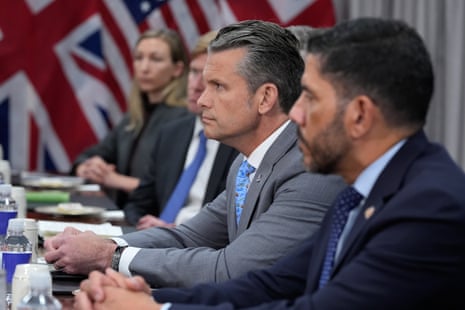
No 10 says US defence secretary Pete Hegseth ‘wrong’ to say most non-US Nato soldiers in Afghanistan didn’t fight
Downing Street has delivered a rare public reprimand to a member of Donald Trump’s administration, saying Pete Hegseth, the US defence secretary, was “wrong” to suggest that most non-American Nato soldiers in Afghanistan did not do any fighting.
Hegseth made the comment in a speech at the University of Tennessee, where he recalled serving in Afghanistan himself. He said:
I was a captain in Afghanistan and we would go to the headquarters in Kabul and there would be 50 flags at the headquarters. It was a beautiful thing to see, 50 different countries contributing to the Nato alliance and the Isaf [International Security Assistance Force] mission there.
Except there were maybe five that contributed. It was actually closer to one or two that by the end were actually involved in kinetic operations. In fact the patch Isaf, we joked it meant ‘I Saw Americans Fighting’.
Asked about Hegseth’s comment at the Downing Street lobby briefing, the PM’s spokesperson said Hegseth was “wrong” in what he said about the Nato operation in Afghanistan.
The spokesperson explained:
The facts speak for themselves when it comes to the UK’s and Nato’s contribution to Afghanistan. Thousands of British and Allied families made huge sacrifices to play their significant part in that war and uphold our values, and more than 450 British personnel never returned.
Their sacrifice and that of other Nato forces was made in the service of collective security and in response to an attack on our ally. We are incredibly proud of our armed forces and their service and sacrifice will never be forgotten, and it is wrong to diminish their role.
While the UK government disagrees with much of what Donald Trump and his team say and do, there is normally a reluctance to criticise them in public. However, this does not seem to apply when the reputation of British servicemen and women has been impugned. Keir Starmer tried hard to maintain a good personal relationship with the US president, but when Trump made a similar claim about Nato allies avoiding frontline fighting in Afghanistan, Starmer condemned what he said as “insulting and frankly appalling”.

Key events
Israeli general election highlights flaws with PR, David Blunkett claims
This morning Daisy Cooper cited Andy Burnham’s support for proportional representation as evidence that the Liberal Democrats are “winning the battle of ideas”. (See 11am.)
But only up to a point. There are a couple of reports around this morning that show that, while Burnham may personally favour PR, he is yet to convincingly win the argument for it in the parliamentary Labour party.
In an article for PoliticsHome, Harriet Symonds and Matilda Martin point out that some of Burnham’s most senior ministers prefer first-past-the-post. They say:
PoliticsHome understands that Louise Haigh, deputy PM and Burnham’s close ally, has concerns about shifting to PR.
Other Cabinet members have previously voiced reservations about the idea.
In 2022, Angela Rayner, now secretary of state for housing, communities and local government, said she was a “first-past-the-post girl” who was “yet to be convinced by PR”, telling The News Agents podcast that it could allow extremist parties such as the British National Party (BNP) to win House of Commons seats.
And David Blunkett, the former cabinet minister who has been one of Burnham’s political mentors, has written an article for the i restating his longstanding opposition to PR. He says:
In my view, the argument can’t be that “every vote must count”. Each vote already does count, because in order to have winners and losers, people engage in the process which inevitably means that some voters’ preferences will be cancelled out by a greater number preferring another candidate.
Not everyone can have prizes in a democracy. Some candidates lose, some electors are frustrated and annoyed that their candidate didn’t succeed. Hence, the first set of questions about what it is we think this change is going to improve. The second question is why we would believe that electoral reform would change people’s interest or engagement with politics?
Later this month we will have a demonstration of what is the purest form of proportional representation in the world. Namely, the Israeli general election. If there were ever an example of how tiny minorities representing not only outlandish views, but providing a blockage on progress, compromise and long-term outcomes, it has to be this form of PR.
Streeting tells MPs that US still providing ‘vital support’ to Ukraine, and it ‘does know which side it’s on’
Wes Streeting told MPs that the US is still on the side of Ukraine in its war against Russia.
During defence questions, the Lib Dem MP James MacCleary asked about reports that the Ukrainian military were left exposed last week after President Trump reportedly intervened to restrict access to the Starlink internet service for its weapons.
Streeting replied:
It is worth pointing out, after what was unquestionably a challenging week for relations between the United States and Ukraine, that the United States has and does and will continue to provide vital support to Ukraine, whether that’s intelligence sharing or indeed the work we do on procurement with and through the United States, as well as the diplomatic track.
Referring to a meeting he had with Pete Hegseth, his US counterpart, last week, Streeting went on:
This is worth reporting to the house; Pete Hegseth, my US counterpart, was keen to thank the United Kingdom for our leadership of Ukraine.
That would suggest to me the United States does know which side it’s on.
Streeting confirms army has to had cancel some training exercises as cost-cutting measure
Wes Streeting, the defence secretary, is taking questions in the Commons.
When the Reform UK MP Danny Kruger asked him if he agreed it was “absolutely scandalous” that non-essential training had been cancelled by the army, Streeting said that training exercises were taking place for the rest of this year. But he accepted that some future training had been cut.
He told MPs:
When I arrived in the Ministry of Defence, there was an in-year overspend that would have seen us overcommitted by the end of the year.
And, as I did at health, I make absolutely no apology whatsoever for sending a very strong message very early on that, while this government is delivering the biggest sustained increase in defence spending since the end of the cold war, I also expect my department and our armed forces to live within their means.
Here is some more reaction to Amanda Bland MSP leaving Reform UK from opposition parties at Holyrood.
Scottish Lib Dem MSP David Green said:
After a chaotic campaign in the spring, the party has been hit by scandal after scandal, and I’m sure more and more of its MSPs will be taking a long, hard look at what they’ve signed up for.
And a Scottish Conservative spokesperson said:
With Nigel Farage’s Reform being weak and ineffective at Holyrood, the Scottish Conservatives will continue standing up to the SNP and fighting for Scotland’s taxpayers.
Amanda Bland MSP says her principles ‘remain unchanged’ as she declines to give explanation for quitting Reform UK
Amanda Bland has issued a statement about her decision to leave Reform UK and sit as an independent MSP in the Scottish parliament. In it, she does not give an explanation for her move, but she says she entered politics to “champion fairness and common sense, protect women and children, improve public services, support businesses to thrive, and work towards a fairer and more effective criminal justice system” and that those principles remain “unchanged”. She implies she has concluded that Reform UK’s priorities lie elsewhere.
Back to Scotland, and here are comments from three Scottish journalists on Amanda Bland leaving Reform UK to sit as an independent MSP. (See 12.21pm.)
From Andrew Learmonth from the Herald
A Reform source says Amanda Bland was due to be hauled in front of Reform’s chief whip Max Bannerman and chief of staff Martyn Green on Wednesday, after her office fell apart. They say she sacked one member of staff and another quit.
From Gina Davidson from LBC Scotland
Reform reduced to 16 MSPs in Holyrood with resignation of Amanda Bland (she’s now an independent), which makes Scottish Labour the largest opposition party on 17. Reform sources say she “wasn’t a team player” & had lost 2 staff members since May. She’s yet to make a statement.
From Stephen Daisley from the Scottish Daily Mail
Labour becomes the largest opposition party in the Scottish Parliament for the first time since 2016.
With Amanda Bland’s resignation from Reform, the party balance is now:
SNP 57
Labour 17
Reform 16
Green 15
Con 12
Lib Dem 10
Ind (Bland) 1
No affiliation (Presiding Officer) 1
Children’s commissioner says devolution should be ‘clean break’ chance to raise standards in services for children
In a speech this afternoon, Dame Rachel de Souza, the children’s commissioner for England, is going to argue that devolution of power to local authorities could help to address some of the problems identified in her Childhood Lottery report. (See 9.34am and 10.05am.)
She is expected to say:
Devolution represents an opportunity. It offers a clean break. The chance for a line in the sand moment. The problems I have identified are not just at a service level – though sometimes they are – they are utterly systemic. The system change that devolution represents is a unique chance to remove the extreme inequality and unfairness I have found.
New powers will mean new structures, and therefore new opportunities to think about, listen to, and deliver for children. Local areas must be provided with support from central government to raise standards for children across health, social care, housing and communities, with urgent action where it falls beyond a set level. This needs to be our response to the emergency.
Given that devolving power from Whitehall to mayors and local authorities is one of Andy Burnham’s top priorities, citing this as the solution to the problems facing children in England is at the very least de Souza being tactful; it might even ensure children’s issues are higher up the agenda in the discussion about what powers should be removed from Whitehall.
But it is also an unusual argument to make in this context because devolution is often seen as a policy that increases the chance of a ‘postcode lottery’ in service provision; a more conventional policy response would be to say that, if there is a “staggering” variety in outcomes, standards should centralised.
The Sun today has splashed on a story saying that the government intends to tighten rules intended to discourage supermarkets from promoting foods that are high in fat, sugar and salt. In his colourful intro, Jack Elsom says “supermarket deals on items like bran flakes, porridge and fruit juice are set to be banned as nanny-state ministers tighten barmy rules on ‘less healthy’ food”. Elsom is referring to what could be included in ‘three-for-two’ deals.
At the Downing Street lobby briefing, asked about the story, the PM’s spokesperson did not exactly knock it down. Without commenting on the detail, he said:
We’re committed to giving children the best start in life, both by supporting families with the cost of living and through measures to protect kids’ health. With one in 10 reception-age children now obese, and one in five have tooth decay by the age of five, we can’t allow this situation to continue.
We’re determined to set children up for happy, healthy lives, and given obesity costs the NHS £9.3bn pounds a year, it’s clear we need to take action.
No 10 says US defence secretary Pete Hegseth ‘wrong’ to say most non-US Nato soldiers in Afghanistan didn’t fight
Downing Street has delivered a rare public reprimand to a member of Donald Trump’s administration, saying Pete Hegseth, the US defence secretary, was “wrong” to suggest that most non-American Nato soldiers in Afghanistan did not do any fighting.
Hegseth made the comment in a speech at the University of Tennessee, where he recalled serving in Afghanistan himself. He said:
I was a captain in Afghanistan and we would go to the headquarters in Kabul and there would be 50 flags at the headquarters. It was a beautiful thing to see, 50 different countries contributing to the Nato alliance and the Isaf [International Security Assistance Force] mission there.
Except there were maybe five that contributed. It was actually closer to one or two that by the end were actually involved in kinetic operations. In fact the patch Isaf, we joked it meant ‘I Saw Americans Fighting’.
Asked about Hegseth’s comment at the Downing Street lobby briefing, the PM’s spokesperson said Hegseth was “wrong” in what he said about the Nato operation in Afghanistan.
The spokesperson explained:
The facts speak for themselves when it comes to the UK’s and Nato’s contribution to Afghanistan. Thousands of British and Allied families made huge sacrifices to play their significant part in that war and uphold our values, and more than 450 British personnel never returned.
Their sacrifice and that of other Nato forces was made in the service of collective security and in response to an attack on our ally. We are incredibly proud of our armed forces and their service and sacrifice will never be forgotten, and it is wrong to diminish their role.
While the UK government disagrees with much of what Donald Trump and his team say and do, there is normally a reluctance to criticise them in public. However, this does not seem to apply when the reputation of British servicemen and women has been impugned. Keir Starmer tried hard to maintain a good personal relationship with the US president, but when Trump made a similar claim about Nato allies avoiding frontline fighting in Afghanistan, Starmer condemned what he said as “insulting and frankly appalling”.
Scottish Labour becomes second biggest party at Holyrood after MSP quits Reform UK to sit as independent
Reform UK has lost one of its MSPs in Scotland. Amanda Bland, a former teacher and police officer who is a list MSP for Central Scotland and Lothians West, has left the Reform UK group and will sit as an independent. She has not publicly said why.
At the May elections Reform UK and Scottish Labour came joint second in terms of seats, with both parties having 17 MSPs, behind the SNP’s 58. Bland’s move means Reform UK is now the third biggest party at Holyrood.
A Reform UK spokesperson said:
We can confirm Amanda Bland has resigned as a Reform UK member of the Scottish parliament to sit as an independent MSP.
We are proud of a talented and united team of MSPs at Holyrood who have supported each other at every step of the way.
Amanda Bland should reflect on her reasons for choosing to isolate herself from that team of capable individuals.
It is incumbent on her to resign as a regional MSP for Central Scotland and Lothians West and allow her constituents to be represented by the next Reform candidate on that list.
Jackie Baillie, the deputy leader of Scottish Labour, said:
No one will be surprised to see chaos at the heart of Reform. They have always been a group of chancers, grifters and Tories in disguise.
Despite all the big talk and promises ahead of the election, Nigel Farage’s party has been utterly useless at holding the SNP to account or getting results for the Scottish people, it’s been a series of stunts, gimmicks, photocalls and precious little else.
Scottish Labour is now the second largest party at Holyrood, and we will work to hold the SNP to account and deliver better outcomes for the people of Scotland.
Bland’s move means Malcolm Offord, Reform UK’s leader in Scotland, will lose the right to be the first opposition leader called at first minister’s questions every other week.
While Reform UK enjoyed great success at the elections in May, it has done less well retaining elected representatives. In the Welsh Senedd Sarah Cooper-Lesadd defected last month from Reform UK to Plaid Cymru, the governing party. And, according to a Best for Britain tracker, there are also 63 people elected as Reform UK councillors in May who have either resigned from office, been suspended or left the party.
Burnham lays wreath at Aberfan cemetery ahead of 60th anniversary of disaster on Wednesday
Asked if she would rule out launching a leadership challenge against Ed Davey, Cooper replied: “Yes, I can. I’m not going to be launching any kind of bid at all.” She went on:
I really enjoy being deputy leader to Ed. We work incredibly well as a team. And I’ve got a lot of work to do as Treasury spokesperson, not least next week when I hold the government to account on their budget.
Cooper claims pensions triple lock in current form still needed because its work has ‘still some way to go’
Asked if the Lib Dems would commit to keeping the pensions triple lock in its current form in their election manifesto, Cooper said she would not write the next manifesto now. But she defended it strongly. She said:
On the triple lock – and these are my views – we are incredibly proud as a party of what the triple lock has achieved. It was our policy implemented in government during coalition. It’s been a resounding success. It’s taken loads of pensioners out of poverty. And it has almost eliminated the gender pension gap between men and women as well.
I don’t believe that the work of the triple lock has been done yet. I think there is still some way to go to make sure that the pensioners of today and the pensioners of tomorrow don’t fall into poverty.
Andy Burnham plans to replace the pensions triple lock with a less generous version, coming into effect from 2030. He wants to legislate for this before the next election.